Almost every substrate producer has run into this at some point. You’re working with a proven recipe. The moisture measurement checks out perfectly.
And yet, during incubation, something goes wrong. Colonization slows or stalls. Free water begins to appear, often pooling at the bottom of the bag. Soon after, you may notice the first signs of bacterial activity.
The immediate conclusion is almost automatic: “I must have added too much water. My measurement must be off.” But that explanation is often misleading.
Moisture is not the real variable
Two substrate bags can contain exactly the same amount of water. Measured correctly. Yet one colonizes evenly and vigorously, while the other develops patchy, inconsistent growth. So what’s really happening?
Moisture content tells you only how much water is present, but NOT:
- where it sits,
- how it is distributed,
- or how it behaves within the substrate.
Mycelium growth is not only influenced by the total amount of water, but also by how that water interacts with the substrate’s structure and the biological processes within it.
The invisible architecture inside every substrate
A substrate is not simply a sponge.
Nor is it just a container of nutrients.
It is a three-dimensional biological structure.
And that structure determines two critical things:
how much water the substrate can hold…
and how much air is available within it.
Between every wood particle…
every straw fragment…
every supplemented particle…
and throughout the entire substrate matrix…
there are thousands of pores and air channels.
Within this network, mycelium respires.
Throughout the substrate, oxygen is consumed and carbon dioxide is produced.
How water interacts with the structure
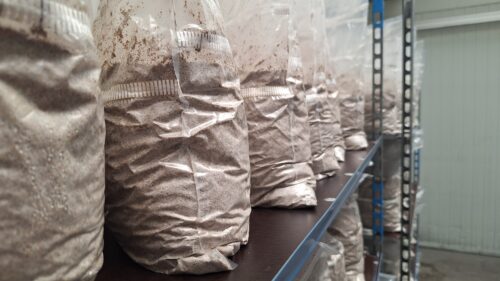
When the structure is balanced, water is retained while enough air space remains for gas exchange.
But when it becomes too fine, compact, or uneven, that balance shifts.
Water may accumulate unevenly and begin to occupy or block the air pores.
Water itself is not necessarily the problem.
The problem is often that too much of the available pore space has become filled with water, leaving insufficient space for gas exchange, or that the substrate cannot retain water properly, making it more vulnerable to contamination.
Water doesn't kill mycelium.
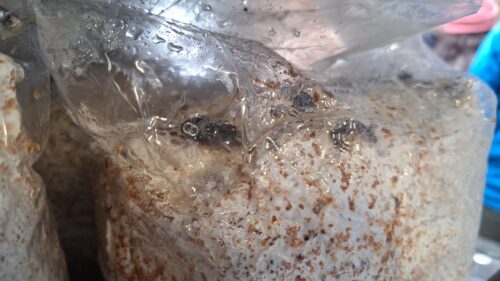
Lack of oxygen does.
Many producers describe a substrate as “too wet.”
What they are actually seeing is:
- reduced oxygen diffusion
- slower gas exchange
- local anaerobic conditions
- increased bacterial competitiveness
The water isn’t the enemy.
The missing air is.
Why two identical recipes behave differently
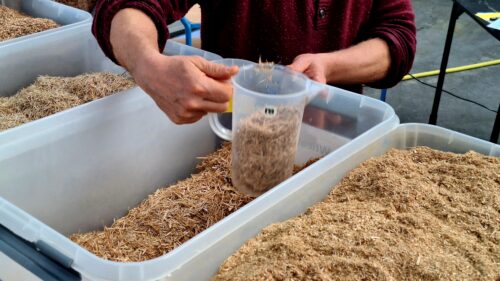
Imagine two sawdust batches.
Batch A contains relatively coarse particles.
Batch B contains a much higher proportion of fine particles than usual.
Both are hydrated up to 65% moisture content.
The measured moisture content is identical.
But the physical structure is not.
Fine particles can pack more closely together.
Large pores become smaller or disappear.
The substrate may compact more easily.
Water can occupy or bridge the remaining pore spaces.
Gas movement becomes more restricted.
Exactly the same moisture content…
but a very different level of oxygen availability.
Structure decides everything
Our senior experts often say that producers don’t just formulate nutrition. They formulate structure.
Because structure determines:
- how water is retained
- how oxygen moves
- how CO₂ escapes
- how metabolic heat spreads
- how evenly mycelium colonizes
That’s why substrate production is never simply about adding ingredients. It’s about engineering a living environment.
Why scaling makes everything harder
This becomes even more important when production grows.
Twenty bags behave differently from two thousand. Larger blocks retain heat. Water moves differently. Pressure changes. Gas exchange becomes less forgiving. Tiny differences in structure suddenly become production problems.
The biology hasn’t changed. The scale has.
The question worth asking
Instead of asking:
Is my substrate wet enough?
Try asking:
- Can oxygen still move?
- Does this structure stay open?
- Where is the water actually sitting?
- How will this behave after seven days of incubation?
Because mushrooms don’t simply grow in water.
They grow in the delicate balance between water…
air…
structure…
and biology.
That balance is what substrate production is really about.

Want this way of thinking applied to your own production?
This short Academy Note only scratches the surface. During our five-day Substrate & Wood Fungi Production Course, participants learn how to recognise these biological interactions in practice, analyse real production situations, and understand why seemingly small decisions can lead to very different outcomes.