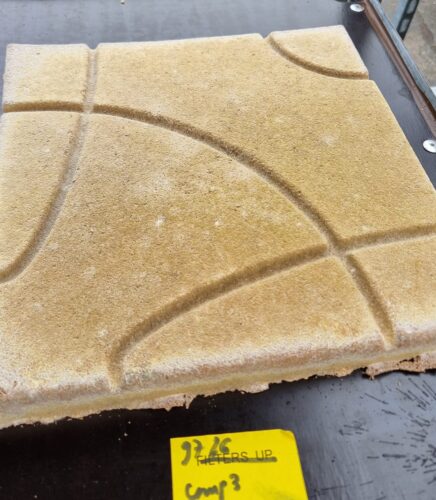
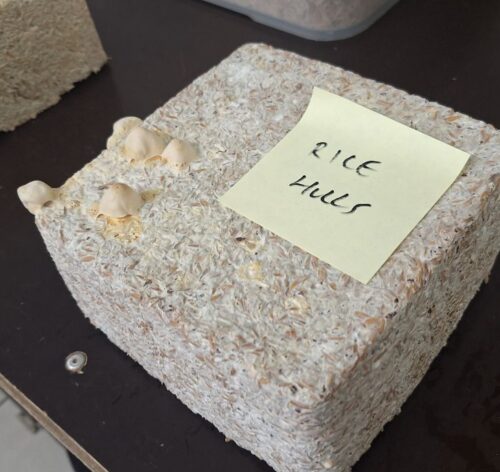
I have a panel in my house that looks slightly out of place. It’s textured and pale – not quite wood, not quite foam. Visitors notice it almost immediately.
“What is this?”
“It’s made from mycelium,” I reply, usually with a bit of pride. That answer rarely ends the conversation. “Seriously? I read about a handbag made from that – it’s in the Hermès collection right now.”
I explain that the handbag consists of relatively pure mycelium, while this panel is a composite – fungal mycelium binding together a lignocellulosic substrate into a rigid form.
“The panel feels nice… kind of fluffy.”
And I can’t disagree. It does feel special – felt-like, but somehow more authentic.
“So, couldn’t we just replace everything with this? That would be more sustainable, right?”
It’s striking how predictable the exchange is. Mycomaterials seem to carry their own storyline. The mere mention of mycelium triggers curiosity. The association with biology suggests sustainability. The object becomes more than a panel – it becomes a symbol. Of circularity. Of innovation. Of a future where materials are cultivated rather than extracted.
The narrative is powerful. It combines two strong forces: the appeal of the unfamiliar – mycelium becoming tangible material – and the promise of environmental improvement. Before performance, cost, or scale entered the discussion, the material already enjoys a conceptual advantage.
But the conversation rarely ends there.
When someone asks whether it is still alive, I explain that it has been inactivated. Soon I find myself describing substrates and structural fillers – the wooden particles that provide bulk. I talk about controlled growth conditions, contamination risks, and incubation time, about drying and post-processing, and about the energy required during manufacturing.
The tone shifts. The panel becomes less of a curiosity and more of an engineered material.
And that shift matters.
Because once we move beyond the narrative – beyond museum pieces and sustainability assumptions – a more fundamental question emerges:
If we strip mycomaterials of their narrative arc, what remains?
Can they truly compete with existing materials, or is their current momentum still largely carried by the strength of their story?
To explore this, we can look at two applications of mycelium-based composites – packaging and insulation panels – and ask a practical question: how do they perform against established solutions?
Packaging: Where Story Becomes Value
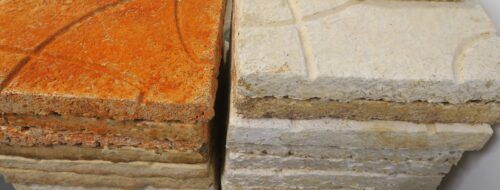
Protective packaging is often presented as the most mature application of mycelium-based composites. Technically, the material can provide effective cushioning and impact protection in many packaging applications. It can be molded into complex shapes, absorbs impact reasonably well, and offers a distinct tactile and visual identity. In certain cases, it can replace expanded polystyrene.
But it does not outperform conventional foams on cost, speed, or process efficiency. Production requires growth time, controlled conditions, and drying. Petrochemical foams are optimized, fast, and cheap. On purely industrial metrics, mycelium packaging is rarely superior.
And yet, it competes.
Why? Because in this segment, appearance and perceived sustainability carry economic value. Premium brands are willing to pay more for packaging that signals environmental responsibility. The material becomes part of the product experience.
Here, sustainability functions not only as a technical characteristic, but as part of the value proposition – one that can justify a price premium in specific contexts.
Personally, I would gladly purchase a gift encased in mycelium packaging. It feels thoughtful. It fits the occasion. But I would not want to pay a premium for every household product presented this way.
Insulation Panels: Where Performance Dominates
In construction, the criteria change. Insulation materials are not chosen for their story. They are chosen for performance, reliability, regulatory compliance, and long-term durability.
Mycelium-based insulation panels can offer promising acoustic absorption and respectable thermal properties. In controlled conditions, they can perform well. But construction is unforgiving. Variability between batches, aging under fluctuating temperature and humidity, and certification requirements quickly become decisive.
Even sustainability becomes more complex in this context. Once translated into formal claims and life-cycle assessments, it must be quantified, documented, and compared against established materials.
Here, the narrative advantage carries far less weight. The material must perform consistently and predictably.
Personally, I would hesitate to use mycelium insulation as the primary thermal barrier in my own home without strong long-term data and clear durability guarantees. On the other hand, I would gladly construct add-on acoustic panels in my small music bunker. In that application, the risk is limited, and the material’s character can even enhance the artistic experience.
Beyond the Story
Narrative matters. It opens doors, attracts investment, and creates tolerance for experimentation. In the case of mycomaterials, the story is particularly powerful. It combines biological intrigue with environmental aspiration. It makes people lean in.
But narrative alone does not sustain a material system.
The two cases reveal a pattern. Mycomaterials compete where story, aesthetics, and perceived sustainability carry economic value – where customers are willing to accept a price premium. They struggle where performance, consistency, price, and long-term guarantees dominate decision-making.
Most successful modern materials went through similar phases. Early plastics were once expensive curiosities before becoming industrial workhorses through scale and cost reduction. Cross-laminated timber began as a sustainability-driven alternative to concrete and steel, questioned for its fire safety, durability, and economics. Only after standardization, testing, and large-scale adoption did it earn structural credibility – and become price-competitive.
Mycomaterials may be in a comparable stage - rich in narrative, still maturing in performance and cost efficiency.
Over time, process optimization, standardization, and scale may reduce variability and bring prices down. At the same time, sustainability will need to move from suggestion to integration within life-cycle frameworks.
If that happens, the material will no longer depend on story-driven acceptance or niche willingness to pay a premium.
It will stand on performance, competitive price, and sustainability.
Best regards,
Frederik Cruyt
Want to explore what mycomaterials production looks like beyond the prototype stage?
This article is part of a broader series exploring what it takes for mycomaterials to move beyond promising concepts and become reliable, scalable and competitive materials.
Because the real questions begin where the story ends: with performance, process, consistency, cost and scale.